

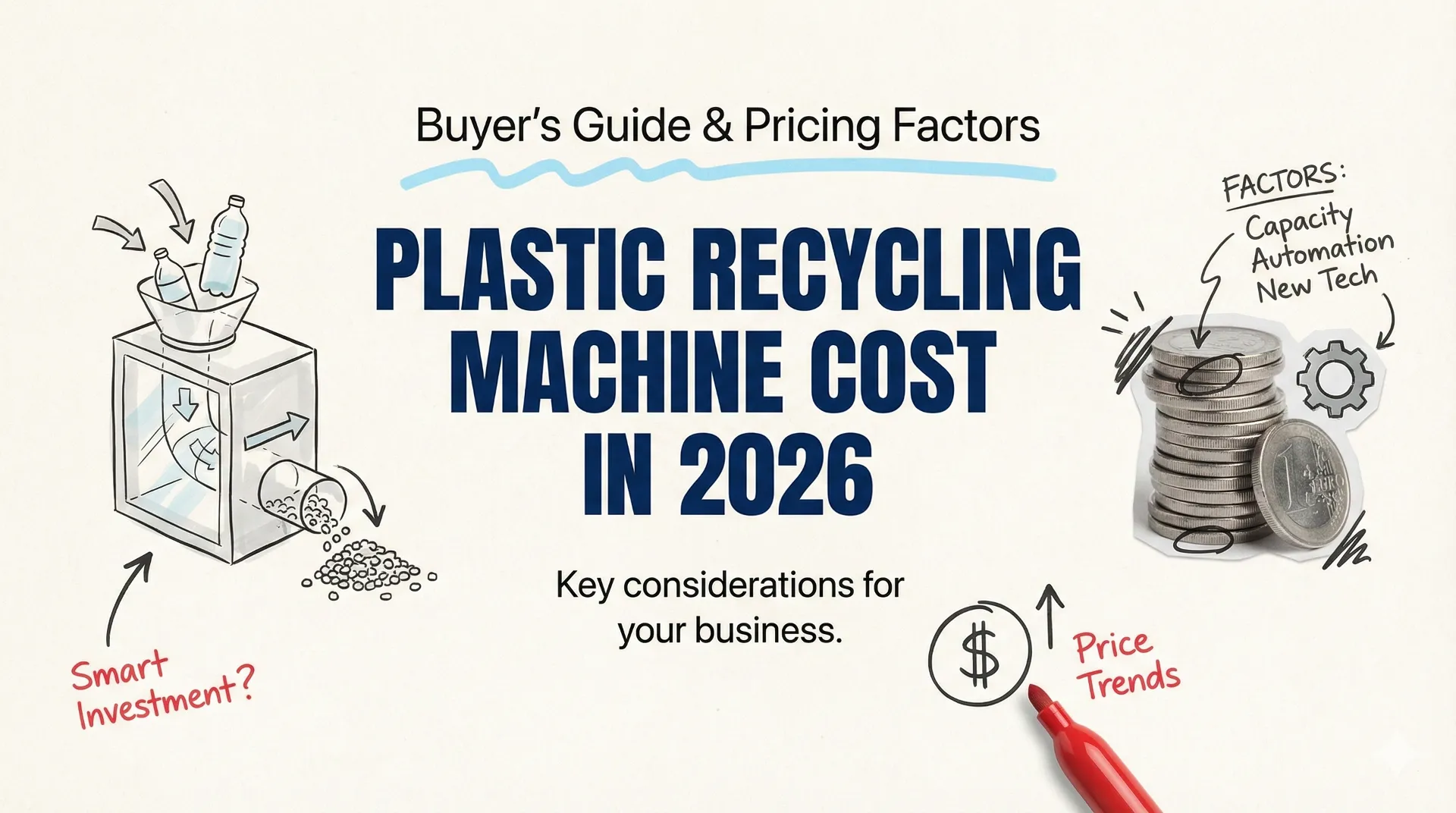
In 2026, the global plastic recycling industry continues to accelerate, driven by stricter environmental regulations, rising raw material costs, and increasing demand for high-quality recycled plastics. For recycling and plastic processing companies, investing in the right plastic recycling machine is no longer just a capital expense—it is a long-term operational decision that directly affects profitability, efficiency, and sustainability.
This guide provides a clear, practical overview of plastic recycling machine costs in 2026, explains what truly drives pricing, and helps decision-makers evaluate equipment beyond the initial purchase price.
Understanding the Price Range in 2026
Plastic recycling machines vary widely in cost depending on configuration, capacity, and automation level. In 2026, typical pricing falls within the following ranges:
- Entry-level or semi-manual machines: USD 10,000 – 30,000
Suitable for small recycling workshops or pilot projects. - Mid-range industrial machines: USD 40,000 – 100,000
Designed for continuous operation with stable throughput. - Fully automated, high-capacity systems: USD 120,000 – 250,000+
Integrated lines with advanced controls, automation, and material recovery optimization.
Rather than focusing on price alone, buyers should evaluate how well a machine aligns with their material type, throughput goals, labor availability, and future expansion plans.
Key Factors That Influence Machine Cost
1. Capacity and Throughput
Processing capacity—typically measured in kilograms or tons per hour—is one of the strongest price drivers. Higher-capacity machines require reinforced frames, larger motors, and more robust transmission systems, all of which increase manufacturing cost but significantly improve productivity.
2. Level of Automation and Control
Automation has become a defining trend in 2026. Machines equipped with PLC control systems, automatic feeding, load monitoring, and fault diagnostics cost more upfront but deliver:
- Reduced labor dependency
- More consistent output quality
- Lower risk of downtime caused by operator error
For medium- and large-scale recyclers, automation often pays for itself within a few years.
3. Build Quality and Engineering Standards
High-quality machines use thicker steel structures, precision-machined components, and wear-resistant materials. While these machines cost more initially, they typically offer:
- Longer service life
- Lower maintenance frequency
- More stable performance during 24/7 operation
This is particularly important for recyclers handling abrasive or contaminated materials.
4. Manufacturer Experience and After-Sales Support
Established manufacturers with proven engineering expertise often charge more, but this premium usually includes:
- Technical support and documentation
- Spare parts availability
- Warranty and commissioning assistance
In industrial recycling, reliable after-sales support is often more valuable than a lower purchase price.
Looking Beyond the Purchase Price: Total Cost of Ownership
A common mistake is evaluating machines based solely on upfront cost. A more accurate approach is to consider the Total Cost of Ownership (TCO), which includes:
- Energy consumption
- Maintenance and spare parts
- Labor requirements
- Downtime and production losses
- Machine lifespan
In many cases, a higher-priced machine with lower operating costs delivers a better return on investment over 5–10 years than a cheaper alternative.
Financing, Leasing, and Incentives
In 2026, more recyclers are using flexible financing solutions to manage cash flow:
- Equipment leasing programs
- Manufacturer-backed installment plans
- Green financing initiatives from banks and development agencies
Additionally, many regions offer subsidies or tax incentives for investments in recycling and environmental technologies. These programs can significantly reduce the effective cost of new equipment.
How to Make a Smart Purchasing Decision
Before committing to a machine, buyers should clearly define:
- Material type and contamination level
- Target throughput and operating hours
- Available floor space and power supply
- Expansion plans for the next 3–5 years
Requesting detailed technical specifications, layout drawings, and energy consumption data helps ensure the machine will meet real-world operating demands.
Conclusion
In 2026, purchasing a plastic recycling machine is a strategic investment that shapes a company’s operational efficiency, product quality, and environmental impact. By understanding what drives machine pricing and focusing on long-term value rather than initial cost alone, recycling companies can make informed decisions that support both profitability and sustainability.
The right machine is not simply the cheapest option—it is the one that performs reliably, scales with your business, and delivers measurable returns over time.
