

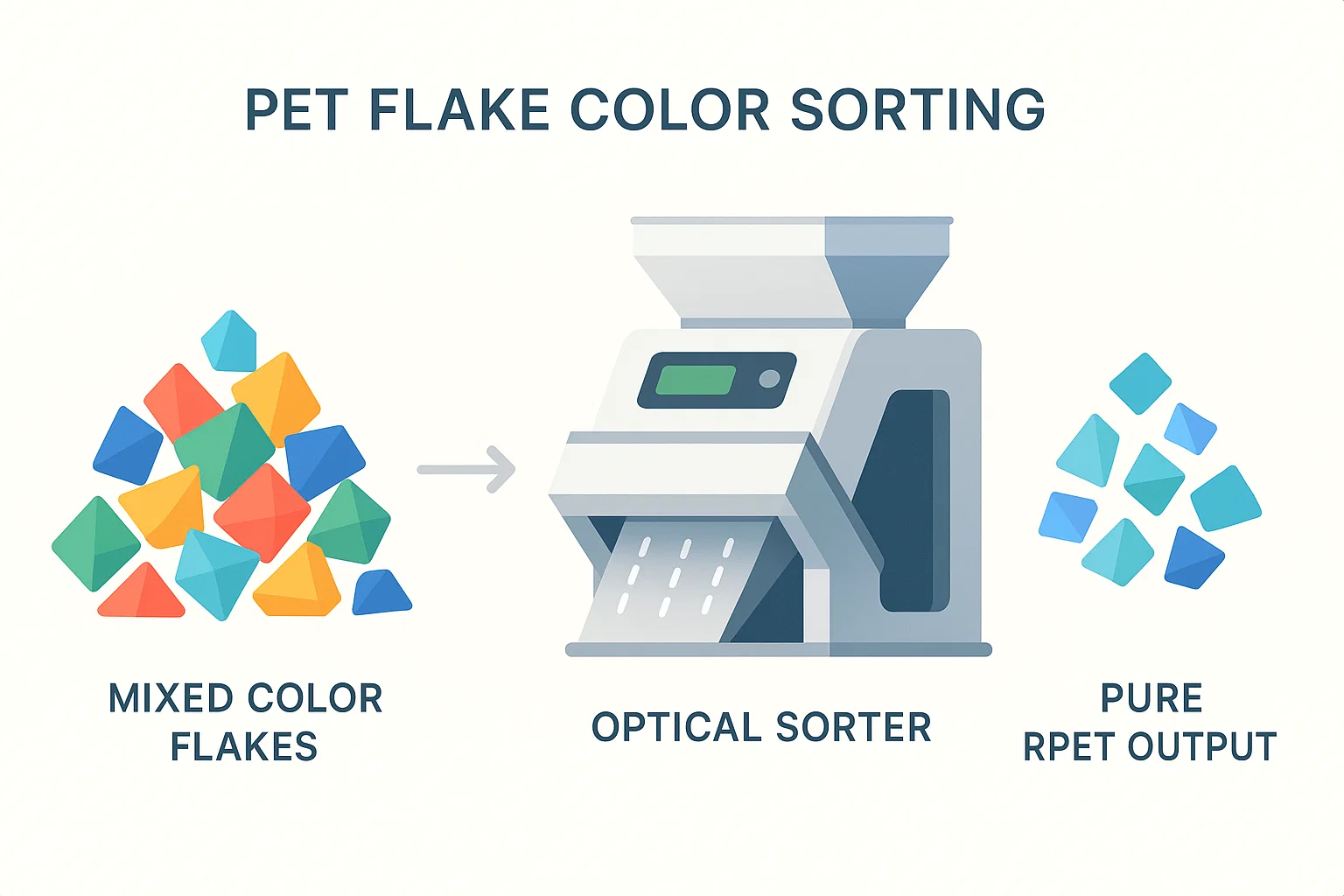
In de wereld van plasticrecycling is kwaliteit de koning. En wanneer het om Polyethylene Terephthalate (PET) gaat – het materiaal van waterflessen en voedselverpakkingen – hangt het bereiken van deze topkwaliteit sterk af van een cruciaal stap: kleur sorteren. Het produceren van hoogwaardige gerecycleerde PET (rPET) korrels die kunnen concurreren met oorspronkelijke plastics is niet alleen het smelten van oude flessen; het is een nauwkeurige wetenschap. Laten we duiken op waarom het zorgvuldig kleur sorteren onmisbaar is voor elke serieuze PET-recyclingoperatie.
Waarom is Kleur Sorteren zo Cruciaal voor Topkwaliteit PET Korrels?
Denk er eens over na zoals het sorteren van ingrediënten voor een gourmetmaaltijd – je wilt alleen het beste, en je wilt dat ze consistent zijn. Kleur sorteren van PET korrels bereikt dat, waardoor het uiteindelijke gerecycleerde materiaal puur, waardevol en klaar is voor een nieuw leven.
Zekerheid en Puurheid Garanderen: De Grondslag van Kwaliteit
Het kan je verbazen, maar niet alle PET is gelijk. De verf en toevoegingen die worden gebruikt om kleurrijke blauwe, groene of amber flessen te maken, kunnen de chemische samenstelling en smeltgedrag van het plastic subtiel veranderen. Deze mengen zonder onderscheid kan leiden tot een onconsistent uiteindelijk product. Kleur sorteren scheidt korrels zorgvuldig af op kleur, waardoor partijen van heldere, blauwe, groene of andere gekleurde rPET consistentie en visuele aantrekkingskracht behouden. Deze uniformiteit is cruciaal voor fabrikanten die vertrouwen op voorspelbare materiaalkenmerken.Verlag van Verontreinigingsniveaus: Uitbannen van Ongewenste Materialen
Verontreiniging is de vijand van hoogwaardige recycling. Ongewenste materialen zoals PVC, andere plastics (PP, PE), overblijvende etiketten, doppen of zelfs gekleurde PET korrels kunnen de kwaliteit van het rPET drastisch verlagen. Geavanceerde optische sorteer technologieën zijn uiterst effectief in het identificeren en uitschakelen van deze verontreinigingen. Door afgekeurde korrels en vreemde materialen te verwijderen, verminderen kleur sorteerders aanzienlijk de verontreiniging, voorkomend problemen zoals verkleuring, verminderde sterkte of verwerking moeilijkheden in het uiteindelijke product.Behalen van Ultra-Hoge Puurheid voor Veeleisende Gebruiken
Voor toepassingen zoals voedselveilig verpakkingsmateriaal of hoogwaardige textiel is puurheid niet alleen wenselijk – het is onmisbaar. Het doel is om rPET te produceren die bijna onherkenbaar is van oorspronkelijke PET. Geavanceerde optische kleur sorteerders, vaak samenwerkend met materiaalsorteerders (zoals die gebruik maken van Nabij-Infrarood of NIR technologie), kunnen zuiverheidsniveaus bereiken die hoger zijn dan 99%. Dit opent deuren voor rPET om te worden gebruikt in waardevolle, gevoelige toepassingen, waardoor het echt de kringloop sluit.Verhogen van Recyclingefficiëntie en Doorstroom
Handmatig sorteren is arbeidsintensief, traag en onderhevig aan menselijke fouten. Automatische kleur sorteer systemen, aan de andere kant, zijn razendsnel en uiterst nauwkeurig. Ze kunnen enorme hoeveelheden PET korrels met consistentie verwerken, 24/7. Dit verhoogt niet alleen de algehele efficiëntie en doorstroom van de recyclinginstallatie, maar vermindert ook de afhankelijkheid van handmatig werk, minimaliseert materiaalverlies en zorgt ervoor dat minder afval in de vuilnisbelt belandt.Behouden van Materiaalintegriteit: Klariteit, Sterkte en Verwerkbaarheid
Zelfs kleine hoeveelheden verontreiniging van afgekeurde korrels of niet-PET materialen kunnen de essentiële eigenschappen van gerecycleerde PET aantasten. Dit kan zich uiten als wazigheid in heldere rPET, verminderde treksterkte of problemen tijdens latere vormings- of extrusieprocessen. Effectieve kleur sortering is cruciaal om de klariteit, structuurintegriteit en gladde verwerkbaarheid te behouden die fabrikanten van hoogwaardige rPET verwachten.Verdediger van de Circulaire Economie: Duurzame Impact
Het uiteindelijke doel van recycling is om een circulaire economie te creëren waar middelen worden gebruikt, hergebruikt en gerecycleerd, waarbij afval en milieubelasting worden verminderd. Hoogwaardige, gekleurde gesorteerde PET korrels zijn veel waarschijnlijk succesvol geïntegreerd in nieuwe producten, vaak meerdere keren. Dit vermindert onze afhankelijkheid van oorspronkelijke plastics (die afkomstig zijn van fossiele brandstoffen), bespaart natuurlijke hulpbronnen en vermindert de broeikasgasemissies die gepaard gaan met plasticproductie.
Het Magie Achter de Machine: Hoe PET Kleur Sorteerders Werken
Dus, hoe gebeurt dit cruciale sorteren? Moderne PET-recyclinginstallaties gebruiken geavanceerde optische sorteerders die technologische wonderen zijn. Hier is een vereenvoudigd overzicht van het proces:
Voorbereiding is de Sleutel: Vóórdat korrels de kleur sorteerder bereiken, ondergaan PET-flessen typisch voorafgaand sorteren (om bulkverontreinigingen zoals andere plastics, metalen en papier te verwijderen), wassen (om etiketten, lijm en residuen te verwijderen) en schrapen in korrels.
Voeden van de Korrels: De schoongemaakte PET-korrels worden vervolgens gelijkmatig gevoed op een hoge snelheidsconveyorband of een goot.
De “Ogen” van de Machine: Terwijl korrels langsrijden, passeren ze een inspectiezone uitgerust met hoge resolutiecamera's (meestal full-color RGB), Nabij-Infrarood (NIR) sensoren en soms gespecialiseerde verlichting.
Camera's: Korrels identificeren op basis van hun kleur.
NIR Spectroscopie: Kan PET onderscheiden van andere plastics (zoals PVC, PE, PP) die misschien vergelijkbaar uitzien maar verschillende chemische kenmerken hebben.
AI Integratie: Veel moderne sorteerders gebruiken Kunstmatige Intelligentie (AI) en machine learning-algoritmen om de sorteernauwkeurigheid continu te verbeteren, subtiele defecten te herkennen en zich aan te passen aan variaties in het invoermateriaal.
Snelle Scheiding: Op basis van de gegevens die door de sensoren zijn verzameld, neemt een verwerkingseenheid een split-second beslissing voor elke vlok. Als een vlok wordt geïdentificeerd als verkleurd, een ander materiaaltype of een verontreiniging, vuurt een batterij precies gerichte luchtstralen een stoot samengeperste lucht af, waardoor de ongewenste vlok uit de hoofdstroom wordt gestoten en in een aparte opvangbak terechtkomt.
Zuivere Output: De resterende stroom bestaat uit hoogzuivere, correct gekleurde PET-vlokken, klaar voor verdere verwerking (zoals smelten en granuleren) tot rPET.
Deze geïntegreerde, multisensorbenadering zorgt ervoor dat alleen de gewenste PET-vlokken, gesorteerd op kleur en materiaalzuiverheid, doorgaan, waardoor de waarde en bruikbaarheid van de gerecyclede output worden gemaximaliseerd.
Investeren in Kwaliteit: De Slimme Keuze voor een Groenere Toekomst
Kleursortering is veel meer dan alleen een esthetische stap in PET-recycling; het is een hoeksteen van kwaliteitscontrole, economische levensvatbaarheid en milieurechtvaardigheid. Door verontreiniging te voorkomen, productconsistentie te garanderen en de productie van hoogwaardig rPET mogelijk te maken dat vergelijkbaar is met virgin materialen, is geavanceerde kleursorteertechnologie onmisbaar.
Voor bedrijven in de kunststofrecyclingindustrie is investeren in robuuste en intelligente kleursorteermachines niet zomaar een operationele upgrade – het is een strategische zet naar grotere efficiëntie, hogere productwaarde en een sterkere inzet voor duurzaamheidsdoelen.
