

Welkom bij “Rumtoo” Plastic Recycling Machinery, waar hoogwaardige PP/PE-folie recyclingmachines onze topprioriteit zijn. Onze machines zijn ontworpen met de kenmerken van eenvoudige bediening, eenvoudig onderhoud en redelijke prijzen. Onze ervaren ingenieurs staan klaar om u gedetailleerde bedieningshandleidingen, technische documentatie en tijdige after-sales service te bieden.
Tegelijkertijd bieden wij ook gratis productontwerp diensten aan. Wij zetten ons in voor het op maat maken van productieoplossingen voor klanten, waardoor de productie efficiënter en milieuvriendelijker wordt, en zo de kernconcurrentiekracht van duurzame ontwikkeling vormt, bijdragend aan wereldwijde energiebesparing, emissiereductie en groene economische ontwikkeling, strevend naar een beter leven.
Onze producten omvatten: plastic recyclinglijnen, plastic waslijnen, shredders, versnipperaars, compactie granulatiesystemen en folie-extruders.
Klanten zijn onze gerespecteerde opdrachtgevers, en uw vereisten zullen hier volledig worden gerespecteerd.

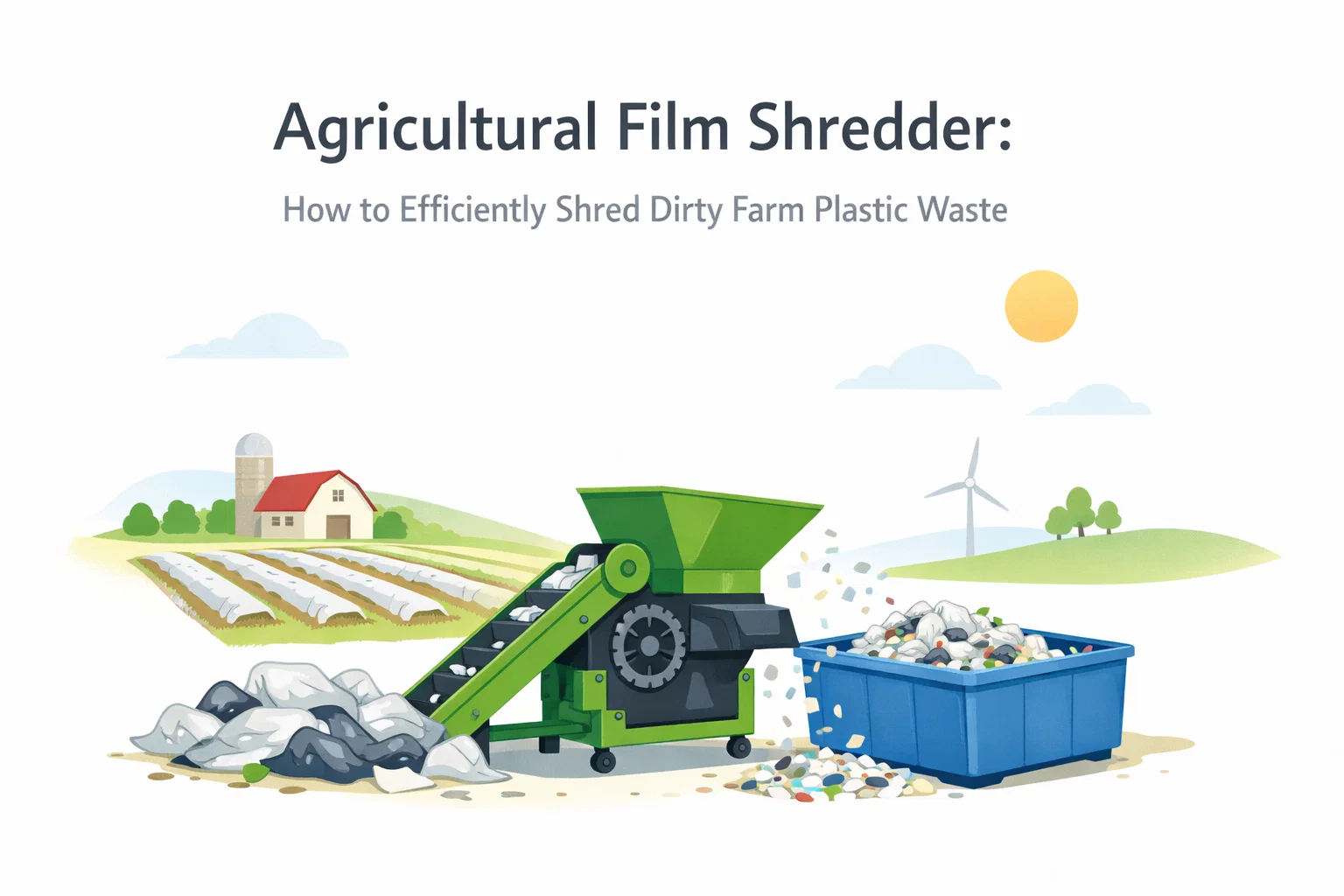
If you run a farm or manage a recycling operation, you know the frustration of facing mountains of used agricultural film at the end of each season. Mulch films, silage wraps, greenhouse covers, and stretch films come off the fields caked in soil, sand, stones, and plant residue. An agricultural film shredder turns that bulky, contaminated mess into uniform flakes you can clean, dry, and turn back into usable plastic pellets.
At Rumtoo, we design and build shredders that handle exactly these tough, dirty materials day in and day out. This guide gives you clear, step-by-step advice so you can process your farm plastic waste efficiently, cut costs, and keep your operation running smoothly. You will learn why shredding matters, how to choose the right machine, and exactly what to do to get reliable results.
The Scale and Challenges of Agricultural Film Waste
Farmers worldwide rely on plastic films to boost yields and protect crops, but the waste adds up fast. Global agricultural plastic use reaches about 12.5 million tons per year, with films making up roughly 60 percent of that total. Mulch films, silage wraps, and greenhouse covers dominate the mix. In the United States, recovered mulch often carries 30 to 80 percent contamination by weight in soil and debris.
That dirt makes everything heavier and harder to handle. Loose film takes up huge trailer space, raises transport bills, and clogs standard equipment. When left in fields or burned, the plastic breaks into microplastics that harm soil structure, water retention, and microbial life. Proper shredding solves the volume issue immediately and prepares the material for effective cleaning.
Why Shredding Is the Essential First Step
Shredding reduces the film to consistent pieces, usually 30 to 80 mm, so downstream washing and drying equipment can work efficiently. Whole sheets tangle and resist cleaning. Flakes expose more surface area for friction washers to scrub away embedded dirt.
The typical flow looks like this: collect and sort from the field, feed into the shredder, transfer flakes to a wash line, dry them, and pelletize. Without a capable shredder upfront, the entire line slows or stops. Machines built specifically for agricultural film manage the stretchiness and grit that would jam ordinary granulators or general-purpose shredders.
Types of Agricultural Film Shredders and How to Choose
Single-shaft shredders with hydraulic ram pushers stand out for this job. The pusher keeps material pressed against a slow-turning rotor fitted with staggered knives. This design delivers steady throughput and resists wrapping. Our single-shaft models for PE/PP film and woven materials reach up to 5,000 kg per hour while producing uniform flakes ready for washing.
Double-shaft shredders use two interlocking rotors to tear large bales or bulky loads apart. They work well as pre-shredders but often pair with a secondary single-shaft unit for finer control.
Specialized thin-film or spiral shredders pull and rip the material with minimal rotor contact to avoid tangles. These suit high-volume stretch-film operations.
When you evaluate machines, focus on these points:
- Throughput that matches your seasonal volume
- Reinforced wear plates and hardened D2 or similar steel knives
- Easy screen and knife access for quick maintenance
- Hydraulic drive for consistent torque on dirty loads
- Automation features such as overload reversal and PLC controls
Test your actual material with the supplier whenever possible. Samples reveal how well the machine handles your specific mix of dirt and moisture.
Explore our specialized single-shaft shredder built for agricultural film and soft plastics.
Step-by-Step Guide to Efficiently Shredding Dirty Farm Plastic
Follow this sequence to achieve consistent results and protect your equipment.
- Collect and Pre-Prepare the Film Remove obvious rocks, metal ties, or large debris at the field edge. Shake or brush off loose soil where practical, but do not aim for spotless material — the wash line will handle the rest. Cut oversized sheets into pieces one person can lift if you feed manually. Bale clean, dry film for easier transport and storage.
- Set Up the Shredder Correctly Place the machine on a solid, level foundation with ample space for infeed and outfeed conveyors. Install the screen size that matches your next process (typically 40–60 mm holes for film). Check all safety guards and emergency stops.
- Feed the Material Steadily Use a conveyor or front-end loader for safety and even flow. Start with a moderate load and increase as you monitor motor current and output quality. Avoid dumping entire bales at once. For very dusty batches, a light water mist at the hopper can reduce airborne particles and begin loosening soil.
- Monitor and Adjust During Operation Watch rotor speed, hydraulic pressure, and discharge rate. If output slows or heats up, reduce feed rate or reverse the rotor briefly to clear any buildup. Keep knives sharp — dull edges increase power draw and produce irregular flakes.
- Transfer and Store Output Move flakes immediately to the wash system via enclosed conveyors to avoid re-contamination. Cover stored flakes if they sit for more than a day.
Operators who follow this routine report steady runs of several hours with minimal stops. Training your team on these habits pays off quickly in higher daily output.
See our full range of plastic shredders designed for demanding recycling tasks.
Overcoming Common Shredding Problems
Tangling and wrapping top the list of frustrations with film. Anti-wrap rotor geometry and proper knife spacing solve most cases. If you still see buildup, pre-cut sheets longer than your rotor width or add a pre-shred step.
Abrasive dirt wears knives faster than clean plastic. Schedule inspections every 40–80 hours of operation and rotate or flip knives. Many operators keep a spare set on hand and sharpen them off-site.
Clogged screens reduce throughput. Clean them daily or install an automatic screen cleaner on larger machines.
Dust and noise affect worker comfort. Good ventilation, dust collection, and sound-dampening enclosures keep the area safe and pleasant.
Maintenance That Extends Equipment Life
Daily: Clear the hopper and check for loose bolts. Weekly: Inspect knives, screens, and wear plates. Lubricate bearings. Monthly: Service the hydraulic system and check motor alignment.
With these habits, quality shredders process hundreds of tons of dirty film before major overhauls. The investment in preventive care returns many times over in uptime and lower repair bills.
Building a Complete Recycling Line Around Your Shredder
Shredded flakes move best into a friction washer that scrubs with high-speed paddles, followed by rinse tanks, a dewatering centrifuge or squeezer, and a hot-air dryer. Pelletizing comes next — either single-stage for clean material or double-stage for dirtier loads.
Pairing the right shredder with the downstream equipment creates a smooth, continuous flow. Many farms and small recyclers start with a shredder-washer combination and expand as volume grows.
Real Benefits for Your Bottom Line and the Environment
Shredded material ships at a fraction of the original volume, slashing freight costs. Clean, pelletized LDPE sells for a solid return that often covers the entire operation within one to two seasons.
On the environmental side, you keep plastic out of landfills and fields. The U.S. Environmental Protection Agency highlights improved collection and processing of agricultural plastics as key to reducing pollution. You also cut microplastic buildup that affects soil health for years to come.
Veelgestelde Vragen
Can I shred really wet or muddy film?
Yes. Robust single-shaft models handle high moisture and soil content. Follow with strong friction washing to remove the rest.
How much contamination is acceptable?
Most lines tolerate 20–40 percent dirt entering the shredder. Higher levels work if you accept faster knife wear and stronger downstream cleaning.
What safety steps matter most?
Lockout-tagout before maintenance, keep hands clear of the hopper, and use conveyors instead of manual feeding whenever possible.
How do I get started if I only have a few tons per season?
Many operators share a mobile shredder unit or partner with a local recycler until volume justifies buying their own machine.
You do not have to let dirty farm plastic waste pile up and drain your time and resources. A well-chosen agricultural film shredder plus these practical steps gives you control over the material and turns a disposal headache into a manageable, even profitable, part of your operation.
Ready to process your waste more efficiently? Share details about your film types and volume, and we will help you find the right configuration.
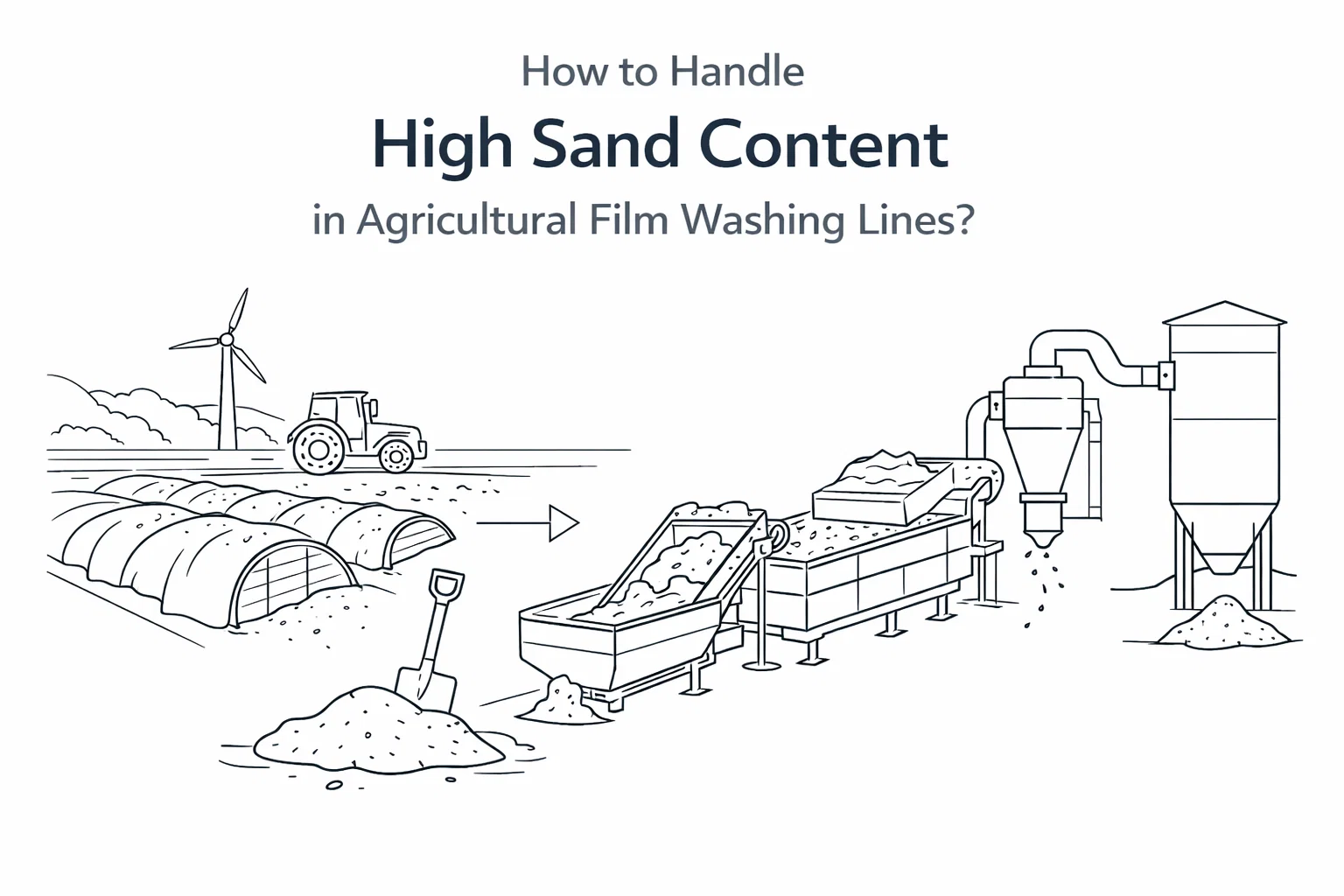
If you run an agricultural film washing line in the US market, you already know the biggest problem is not plastic itself. It is the sand and soil packed into used mulch film after field use.
Sand is abrasive. It wears shredder knives, damages pumps, clogs screens, and shows up later as hard inclusions that drag down pellet quality. The most reliable approach is not one “strong” washer, but a staged process designed to remove heavy contamination early and keep it from recirculating:
- Pre-washing (Pre-wash) to knock off bulk dirt and break up clumps.
- Friction washing (Friction washer) to detach stubborn sand and soil from folds and creases.
- Sink-float separation (Sink-float tank) to continuously reject sand, stones, grit, and other heavy contaminants once they are fully released into the water stream.
This guide explains how to combine these steps to remove sand from plastic film efficiently, protect your equipment, and stabilize downstream extrusion.
Why agricultural mulch film carries extreme sand load
Post-consumer agricultural film (especially field-collected mulch film) typically arrives with:
- Soil and fine sand embedded into wrinkles and folds
- Stones, grit, and occasional metal pieces from collection and baling
- Organic residues such as roots and plant matter
- Moisture and sticky contaminants (pesticides, fertilizers, adhesives)
If sand is not removed early, it will:
- Accelerate wear on shredder knives and cutting chambers
- Increase abrasion in friction washers, pumps, and piping
- Reduce sink-float efficiency as the tank turns into “mud water”
- Increase melt filtration load and screen-change frequency during pelletizing
The proven combo: Pre-washing + Friction washing + Sink-float
Instead of trying to fix everything in one place, design the agricultural film washing line te verontreiniging verwijderen in fases.
1) Voorwassing (Voorwassen)
Doel: Loose zand en aarde verwijderen voordat intensieve wassing en scheiding.
Wat voorwassing goed doet:
- Op zandrijk mulchfilm kan een goed ontworpen voorwassing tot 60–70% van zware vastzittende deeltjes (zand/aarde/korrel) verwijderen voordat de hoofdwasfase begint.
- Vermindert de vuilbelasting die de kernwasfase binnenkomt
- Voorkomt aardeopbouw over de hele lijn
- Verbeterd de stabiliteit van de afvoersink-float en wrijvingswas
Praktische beste praktijken:
- Gebruik voldoende roering om gecondenseerde aarde te breken.
- Inclusief een eenvoudige ontzandings/settelingsruimte zodat zware deeltjes kunnen vallen en kunnen worden afgevoerd.
- Houd de voorwaszone gemakkelijk toegankelijk voor schoonmaak.
2) Wrijvingswas (Hoog-snelheids scrubben)
Doel: Mechanisch schrob aarde en residu van de filmoppervlak.
Wrijvingswas is de ruggengraat van de vuile mulchfilm omdat het:
- Schrob ingeslopen aarde uit vouwen en vouwen
- Breekt de band tussen zand en plasticoppervlak
- Helpt organische residuen en plakkerige verontreinigingen te verwijderen
Waarom we wrijvingswas voor sink-float plaatsen voor zandrijk mulchfilm:
- Wrijvingswas verwijdert koppige zanddeeltjes zodat deze vrijkomen in het waterstroom.
- In de volgende stap kan de sink-float tank deze vrijgekomen zware deeltjes betrouwbaar afwijzen.
Belangrijke overwegingen:
- Hoog rotor snelheid plus een goed afgestemd scherm verbetert het schrobproces.
- Een constante voedingsrate voorkomt overbelasting en houdt de schoonmaak consistent.
- Een gelijke sproei- en spoelwaterverdeling ondersteunt het wassen zonder het systeem om te zetten in een moddercirculatie.
3) Zinken-float scheiding (Dichtheidsscheiding)
Doel: Gebruik dichtheidsverschillen om zware vervuiling te verwijderen.
In een zinken-float tank:
- PE-film zinkt
- Zand, aarde, stenen, korrels en metaal zinken
Waarom deze stap essentieel is voor het verwijderen van zand:
- Het biedt continue afwijzing van zware deeltjes.
- Het beschermt downstream apparatuur en stabiliseert de pelletisatiekwaliteit.
Ontwerp- en bedrijfstips die in de praktijk belangrijk zijn:
- Houd de waterstroom en het peil stabiel om vermenging van afgezette deeltjes te voorkomen.
- Zorg ervoor dat het zinken afvoersectie een hoge zandvolume kan verwerken.
- Houd het tankwater voldoende helder om een stabiele scheiding te waarborgen. Als het tankwater modderig is, daalt de scheidingsefficiëntie.
Aanbevolen processtroom voor hoog vervuild mulch-film
Een gebruikelijke workflow voor zandrijk landbouwfilm ziet er als volgt uit:
- Scheuren / afmeting verminderen
- Voorwas (bulk vuil verwijderen)
- Wrijvingswassen (diepe schrobben)
- Zinken-float tank (zware vervuiling scheiding)
- Ontwatering / drogen (persen + centrifugaal drogen)
- Pelletisatie met filtratie
Afhankelijk van de inputkwaliteit, kunt u een extra spoel of een tweede wrijvingsfase toevoegen. Het kernconcept blijft hetzelfde: verwijder zand vroeg, scheid zware deeltjes continue en schrob grondig.
Hoe kunt u controleren of u daadwerkelijk zand verwijdert
Eenvoudige controles die worden gebruikt op werkende lijnen:
- Visuele controle: de korrels moeten helder en schoon lijken, niet grijs of modderig.
- Depostietest: neem een kopje proceswater en laat het zinken. Zware zinken wijst erop dat er nog steeds vaststoffen in de circulatie zijn.
- Slijtage-indicatoren: herhaaldelijke pompseal-fouten, schermbeschadiging en uitzonderlijk snelle mesveroudering wijzen meestal op slechte vroege zandverwijdering.
- Kwaliteit van de korrels: minder harde inclusions en minder zwarte vlekken wijzen meestal op een betere besmettingscontrole.
Gemene redenen waarom zand in de lijn blijft
- Over het skippen van het voorwassen en het pushen van al het vuil naar de wrijvingswassing
- Het laten draaien van het sink-float reservoir met modderig water (de scheiding wordt onstabiel)
- Het kiezen van een te klein zinken afvoer (zand bouwt zich op en keert terug naar het proces)
- Het verwachten dat één tank of één wasser een gestage besmettingsprobleem oplost
Apparatuurreferentie: Landbouwfolie wassen & recyclingsmachine
Voor een volledige lijn ontworpen voor hoge besmetting landbouwfolie, zie:
Samenvatting
Om remove sand from plastic film op industriële schaal, concentreer u zich op procesontwerp - niet alleen op één stuk apparatuur. Een betrouwbare agricultural film washing line combineert:
- Voorwas om de massa vuilbelasting te verminderen
- Zinken-sink separatie om zwaar vervuiling te verwijderen
- Wrijvingswassen om de aarde uit vouwen en vouwen te schrobben
Correct uitgevoerd, verbetert deze combinatie de zuiverheid, vermindert de slijtage en houdt het pelletisatieproces stabiel.
