

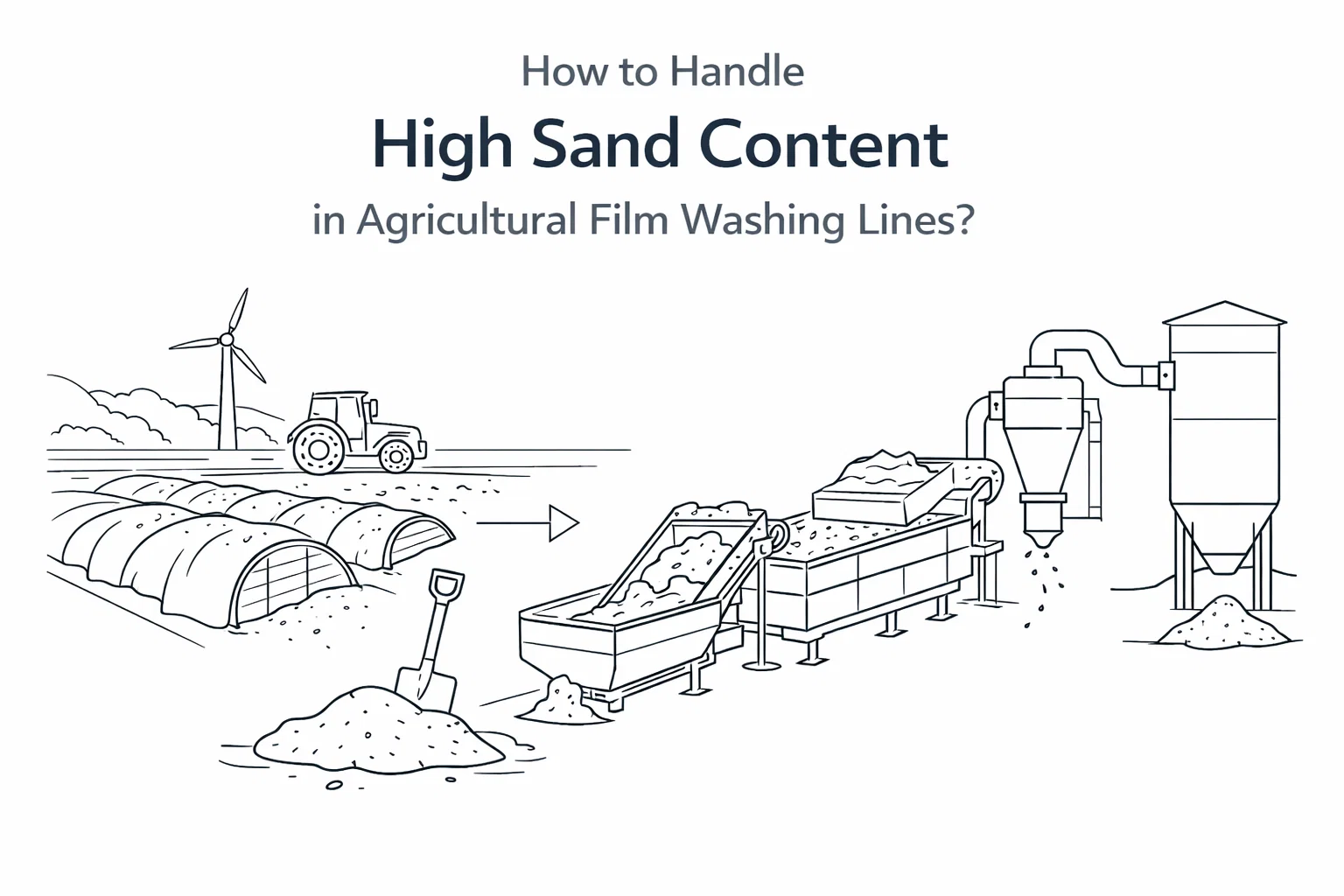
If you run an agricultural film washing line in the US market, you already know the biggest problem is not plastic itself. It is the sand and soil packed into used mulch film after field use.
Sand is abrasive. It wears shredder knives, damages pumps, clogs screens, and shows up later as hard inclusions that drag down pellet quality. The most reliable approach is not one “strong” washer, but a staged process designed to remove heavy contamination early and keep it from recirculating:
- Pre-washing (Pre-wash) to knock off bulk dirt and break up clumps.
- Friction washing (Friction washer) to detach stubborn sand and soil from folds and creases.
- Sink-float separation (Sink-float tank) to continuously reject sand, stones, grit, and other heavy contaminants once they are fully released into the water stream.
This guide explains how to combine these steps to remove sand from plastic film efficiently, protect your equipment, and stabilize downstream extrusion.
Why agricultural mulch film carries extreme sand load
Post-consumer agricultural film (especially field-collected mulch film) typically arrives with:
- Soil and fine sand embedded into wrinkles and folds
- Stones, grit, and occasional metal pieces from collection and baling
- Organic residues such as roots and plant matter
- Moisture and sticky contaminants (pesticides, fertilizers, adhesives)
If sand is not removed early, it will:
- Accelerate wear on shredder knives and cutting chambers
- Increase abrasion in friction washers, pumps, and piping
- Reduce sink-float efficiency as the tank turns into “mud water”
- Increase melt filtration load and screen-change frequency during pelletizing
The proven combo: Pre-washing + Friction washing + Sink-float
Instead of trying to fix everything in one place, design the agricultural film washing line para eliminar contaminación en etapas.
1) Lavado previo (Lavado previo)
Objetivo: Quitar arena y suelo suelto antes de Lavado y separación intensivos.
Qué hace bien el lavado previo:
- En el film de mulch con mucho arena, un lavado previo bien diseñado puede quitar hasta 60–70% de sólidos pesados (arena/suelo/arena de grano) antes de los pasos de lavado principales.
- Reduce la carga de suciedad que entra en tus pasos de lavado principales
- Previene la acumulación de barro a lo largo de toda la línea
- Mejora la estabilidad del lavado de sedimentación y fricción en el flujo descendente
Prácticas recomendadas:
- Usar suficiente agitación para romper el suelo compactado.
- Incluir un área simple de desarenado y sedimentación para que las partículas pesadas puedan caer y ser descargadas.
- Mantener la zona de lavado previo fácilmente accesible para la limpieza.
2) Lavado de fricción (Fregar a alta velocidad)
Objetivo: Fregar mecánicamente el suelo y los residuos de la superficie del film.
El lavado de fricción es el paso más importante para el film de mulch sucio porque:
- Frega el suelo incrustado en pliegues y pliegues
- Rompe el vínculo entre la arena y la superficie plástica
- Ayuda a eliminar residuos orgánicos y contaminantes pegajosos
Por qué colocamos el lavado de fricción antes que la sedimentación para el film de mulch con mucho arena:
- El lavado de fricción desengancha la arena incómoda, convirtiéndola en sólidos libres en el flujo de agua.
- En el siguiente paso, el tanque de sedimentación puede rechazar estos sólidos pesados liberados de manera confiable.
Consideraciones clave:
- Una velocidad de rotor alta más una malla bien ajustada mejora el fregar.
- Una tasa de alimentación constante evita la sobrecarga y mantiene el lavado consistente.
- Una distribución uniforme de agua de rocío y lavado evita que el sistema se convierta en recirculación de barro.
3) Separación de sedimentación (Separación por densidad)
Objetivo: Remover heavy contaminants using density differences.
En un tanque de hundimiento-flotación:
- Película de PE flota
- Arena, suelo, piedras, arena de grano y metales hunden
Por qué este paso es esencial para la eliminación de arena:
- Proporciona rejección continua de partículas pesadas.
- Protege el equipo downstream y estabiliza la calidad de los gránulos.
Consejos de diseño y operación que importan en el mundo real:
- Mantén el flujo y el nivel del agua estables para evitar la mezcla de sólidos sedimentados.
- Asegúrate de que la sección de descarga de hundimiento pueda manejar un alto volumen de arena.
- Mantén el agua del tanque lo suficientemente clara para una separación estable. Si el tanque se ensucia, el rendimiento de separación disminuye.
Flujo de proceso recomendado para mulch de película con alta contaminación
Una flujo de trabajo común para películas agrícolas con arena en abundancia se ve así:
- Trituración / reducción de tamaño
- Lavado previo (remoción de suciedad en masa)
- Lavado de fricción (fregar a fondo)
- Tanque de hundimiento-flotación (separación de contaminantes pesados)
- Desague de agua / secado (apretado + secado centrífugo)
- Granulación con filtración
Dependiendo de la calidad de la entrada, puede agregar un lavado extra o una segunda etapa de fricción. El concepto central sigue siendo el mismo: eliminar la arena temprano, separar sólidos pesados de manera continua y fregar a fondo.
Cómo verificar que realmente estás eliminando la arena
Revisiónes simples utilizadas en líneas en funcionamiento:
- Revisión visual: las escamas deben parecer brillantes y limpias, no grises o turbias.
- Prueba de sedimentación: tome una taza de agua de proceso y déjela sedimentar. Un sedimentación pesada indica que los sólidos aún están circulando.
- Indicadores de desgaste: fallas repetidas de sellos de bomba, daños en la pantalla y desgaste de cuchillas especialmente rápido suelen indicar una mala remoción temprana de arena.
- Calidad de los gránulos: menos inclusiones duras y menos manchas negras generalmente indican un mejor control de contaminación.
Razones comunes por las que la arena se mantiene en la línea
- Saltarse el lavado previo y empujar toda la suciedad al lavado por fricción
- Ejecutar el tanque de sedimentación y flotación con agua turbia (la separación se vuelve inestable)
- Undimensionar el desagüe de sedimentación (la arena se acumula y vuelve al proceso)
- Esperar que un tanque o un lavador resuelva un problema de contaminación estacionada en etapas
Referencia de equipo: Máquina de lavado y reciclaje de películas agrícolas
Para una línea completa diseñada para películas agrícolas altamente contaminadas, vea:
Resumen
Para remove sand from plastic film a escala industrial, enfóquese en el diseño del proceso, no solo en un equipo. Un sistema agricultural film washing line combinado:
- Lavado previo para reducir la carga de suciedad en volumen
- Separación de sedimentación y flotación para rechazar continuamente contaminantes pesados
- Lavado de fricción para limpiar la tierra de pliegues y arrugas
Hecho correctamente, esta combinación mejora la pureza, reduce el desgaste y mantiene la estabilidad de la pelletización.
