


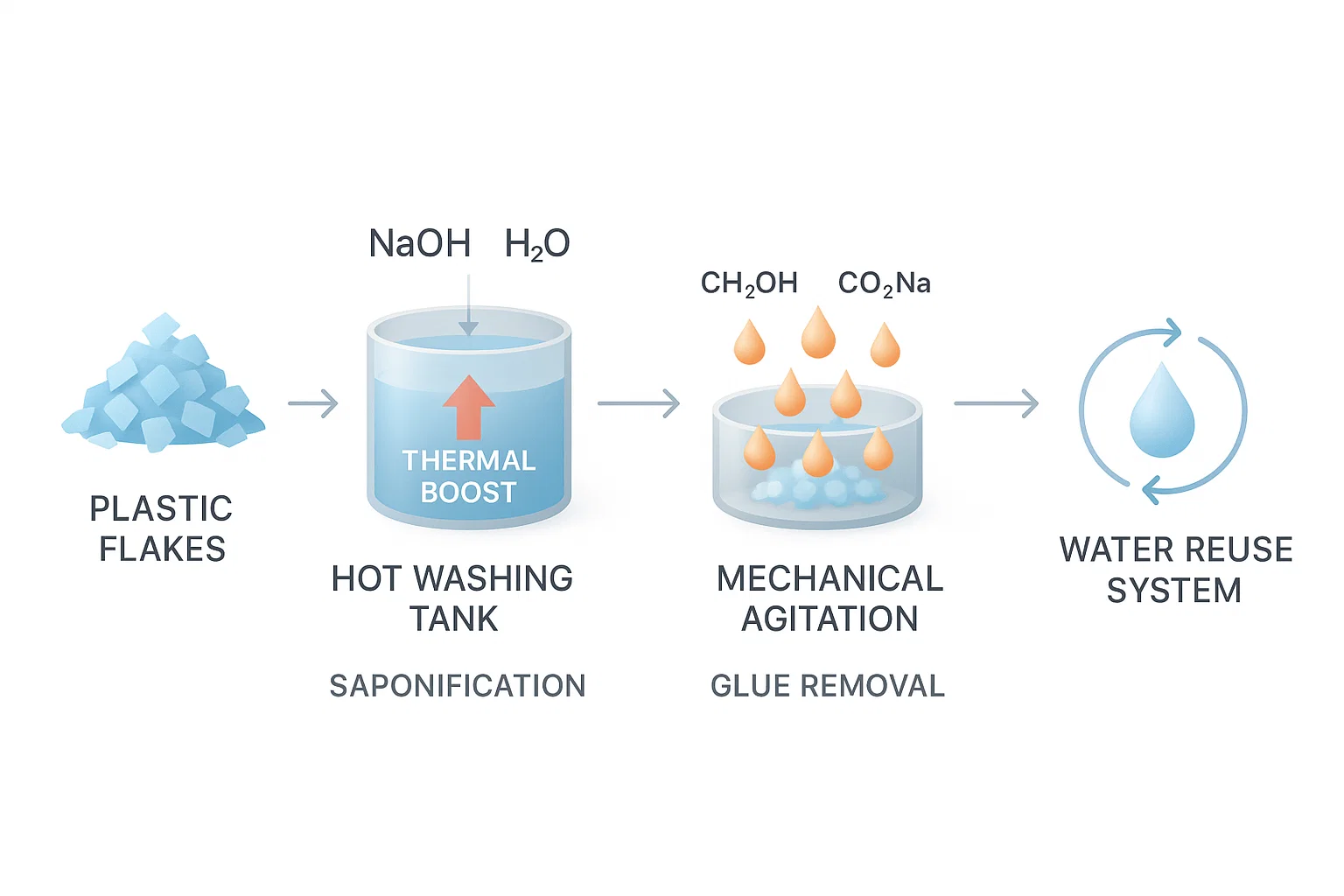
Dans le recyclage des bouteilles en PET, l'une des étapes les plus cruciales est le processus de lavage à chaud, où de l'eau alcaline à haute température est utilisée pour nettoyer les copeaux de plastique. Cette méthode élimine efficacement les contaminants tenaces tels que l'huile, la graisse et le colle de étiquette par une combinaison d'actions chimiques , thermiques , et, mécaniques, . Voici une explication détaillée de la manière dont ce système fonctionne et de ses avantages. mechanical actions. Below is a detailed explanation of how this system works and its advantages.
Chemical Mechanisms
1. Saponification of Oils and Grease
Alcaline water, typically composed of caustic agents such as hidróxido de sodio or hidróxido de potasio, possesses a high pH level (above 7). This establishes an ideal condition for saponificación, a chemical reaction in which fats and oils are transformed into soap-like, water-soluble compounds. These emulsified residues are much easier to rinse off, effectively removing oily contaminants from the PET surfaces.
2. Removal of Adhesives and Glues
The caustic nature of the alkaline solution also breaks down glues and adhesives used for bottle labels. It disrupts the chemical bonds within these sticky substances, loosening them from the plastic surface. To further enhance this effect, surfactants are added. These reduce surface tension, improving the spread and penetration of the solution and facilitating the detachment of stubborn glue residues., Physical and Thermal Effects High Temperature Accelerates Cleaning.
Elevated water temperatures significantly boost the reaction rate of saponification and adhesive breakdown. Heat softens glues and loosens hardened contaminants, making them easier to remove. The thermal energy complements the chemical action for faster and more efficient cleaning.
3. Mechanical Agitation for Deep Cleaning
Hot washing systems often incorporate mechanical agitation through rotary paddles or screw augers. This agitation causes PET flakes to rub against each other, producing friction that physically scrubs off residues like mud, oil, and glue. The combined effect of heat, chemistry, and friction ensures a more thorough cleaning process.
4. Mechanical Agitation for Deep Cleaning
Hot washing systems often incorporate mechanical agitation through rotary paddles or screw augers. This agitation causes PET flakes to rub against each other, producing friction that physically scrubs off residues like mud, oil, and glue. The combined effect of heat, chemistry, and friction ensures a more thorough cleaning process.
Additional Benefits
5. Contamination Control
The high-temperature and caustic environment of the washing process also effectively eliminate biological contaminants such as bacteria and and, mold.
6. , enhancing the hygienic quality of the recycled flakes. This is particularly crucial when recycled PET (rPET) is destined for food-grade or hygiene-sensitive applications.
Water Recycling and Efficiency Modern hot washing systems are equipped with, integrated water treatment and recycling modules , enabling up to 80% Reuse of Hot Alkaline Water This system not only reduces operating costs and water consumption but also ensures consistent cleaning performance by stabilizing temperature and chemical concentration.
Advantages of the Hot Washing System
- - Thorough Cleaning: Effectively removes oil, grease, glue, and labels from PET flakes.- Enhanced Recycling Efficiency: Produces higher-quality recycled PET suitable for various applications.
- - Customizable Setup: Washing conditions (chemical concentration, temperature, and duration) can be adjusted to different contamination levels.- Environmentally Friendly.
- Customizable Setup: Washing conditions (chemical concentration, temperature, and duration) can be tailored to different contamination levels.
- Environmentally Friendly: Integre systèmes de réutilisation de l'eau, réduisant les déchets et la consommation de ressources.
Conclusion
L'utilisation de chimiques dans le recyclage des bouteilles en PET joue un rôle crucial pour obtenir des paillettes de plastique propres et de haute qualité. Grâce à une synergie de saponification chimique, softening thermique, . Voici une explication détaillée de la manière dont ce système fonctionne et de ses avantages. mechanical agitation, ce processus garantit que les contaminants sont complètement éliminés. Le résultat est un flux de travail de recyclage plus efficace et un produit final supérieur, adapté à une large gamme d'applications.